
AI vs. reality: The 2026 Oscars timeline challenge
Updated| March 16, 2026
We compared our November AI Oscar predictions to the actual 2026 results. See where the models were right, where they failed, and why the timeline matters.
TL;DR: Last November, AI models were split on the 2026 Best Picture winner, with Avatar: Fire and Ash and Hamnet leading the polls. Fast forward to today, March 16, 2026: the results are in, and Paul Thomas Anderson's "One Battle After Another" has taken home the gold. While the AIs missed the mark, the shift in momentum highlights how "AI snapshots" capture a specific moment in the awards cycle that reality eventually outpaces.
Table of Contents
What was the prediction timeline?
Where did the AI models miss the mark?
Which "signal" remained true through the ceremony?
FAQs
What was the prediction timeline?
Awards season is a moving target. In late 2025, AI models based their "logic" on early festival buzz and technical expectations. By the time Conan O'Brien took the stage last night for the 98th Academy Awards, the landscape had shifted entirely.
Movie Title | AI Prediction (Nov 2025) | Actual Result (Mar 15, 2026) |
One Battle After Another | Not in the Top 5 | WINNER (Best Picture) |
Avatar: Fire and Ash | 27% (Frontrunner) | Winner (Visual Effects) |
Hamnet | 27% (Frontrunner) | Winner (Best Actress) |
Sinners | 9% (Longshot) | Winner (Best Actor, Screenplay) |
Where did the AI models miss the mark?
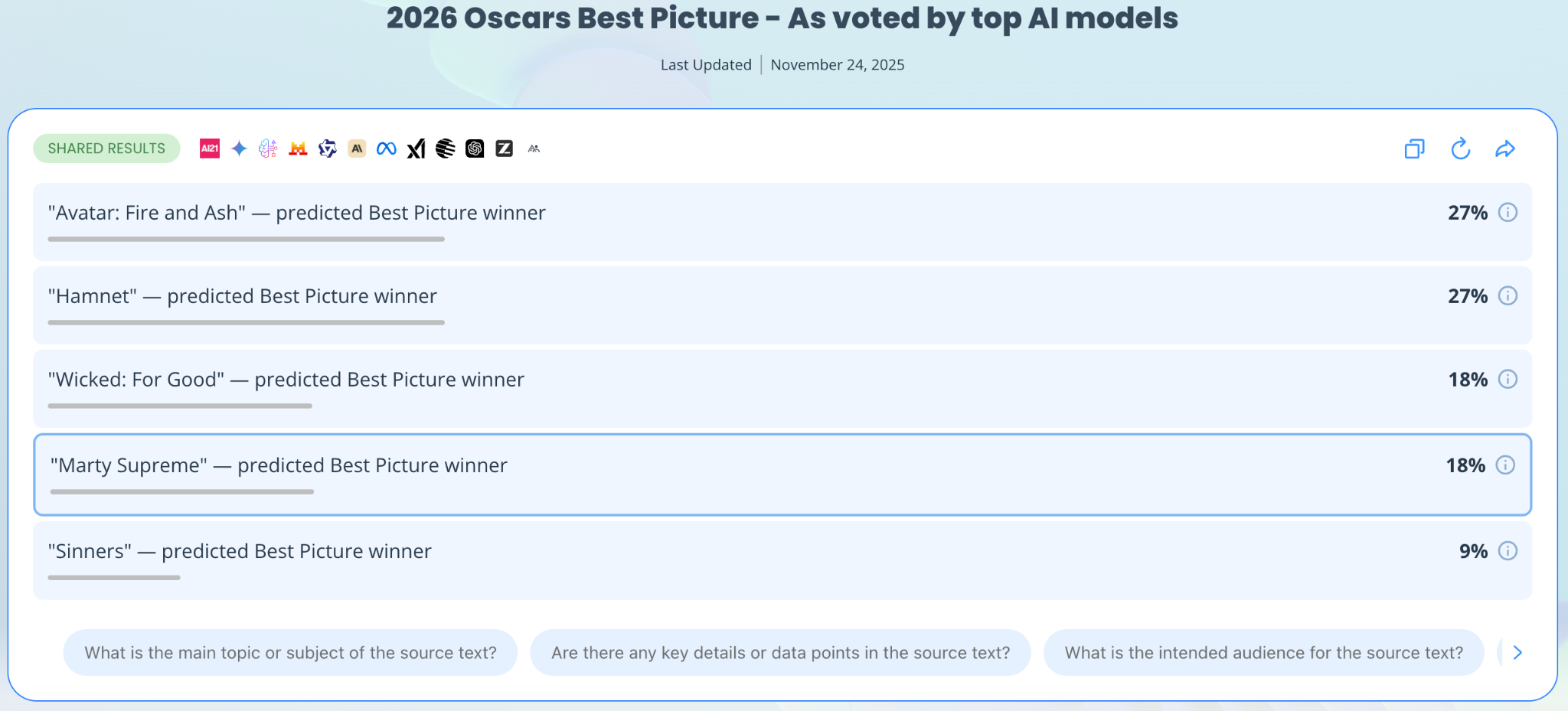
The AI models at Eye2.AI were highly accurate at identifying nominees, but they struggled to predict the late-season surge of Paul Thomas Anderson’s political epic.
How did "One Battle After Another" surge? The film became an awards season juggernaut only after sweeping the BAFTAs and PGAs in early 2026 – data that was not yet "weighted" in the November AI models. It finished the night with six Oscars, including Best Director and Adapted Screenplay.
Why the "blockbuster trap"? Models like Llama and Amazon Nova overvalued the commercial potential of Avatar: Fire and Ash, predicting it for Best Picture when Academy voters ultimately relegated it to technical categories (where it did win Best Visual Effects).
Was the "Sinners" momentum real? While Grok gave it only 9% for Best Picture, the film set an all-time record with 16 nominations and won four major trophies, including Best Actor for Michael B. Jordan.
Which "signal" remained true through the ceremony?
Even though the AIs didn't pick the winner, the Eye2.AI SMART Consensus actually identified every major film that ended up in the winner's circle for individual categories:
The lead actress signal: ChatGPT and Qwen were 100% correct that Hamnet was a "prestige" winner, which translated into Jessie Buckley’s historic Best Actress win last night.
The technical signal: Models that bet on Frankenstein (75% confidence in earlier tests) were validated when the film swept the technical categories, including Best Production Design and Costume Design.
FAQs
1. Why did the AI fail to predict "One Battle After Another"?
AI models reflect the data available at the time of the prompt. In November 2025, the film was still a mystery to general datasets. It wasn't until the "precursor" awards in early 2026 that it became the definitive frontrunner.
2. Can AI actually predict human-voted awards?
AI is excellent at identifying "nomination-worthy" films by analyzing critical sentiment. However, predicting a winner requires accounting for late-breaking momentum and industry politics, which are harder to quantify months in advance.
3. How can I use Eye2.AI to track next year’s race?
By using the side-by-side comparison, you can see how different AI "personalities" view films throughout the year. As the percentages of agreement (consensus) increase closer to the ceremony, the accuracy of the predictions typically sharpens.
By using Eye2.ai, you agree to the Terms and Privacy Policy. Outputs may contain errors.
Download the Eye2.ai app on:

