
Introverts vs. Extroverts: Who actually leads better?
Updated| April 29, 2026
Who leads better: introverts or extroverts? We queried 12 AI models to find the truth. See why EQ and situational leadership beat personality every time.
TL;DR: For decades, the "charismatic extrovert" was the undisputed blueprint for leadership. But in 2026, data-driven research (and the collective intelligence of the world’s top AI models) tells a much more nuanced story. The Eye2.AI Consensus is clear: neither personality type has an inherent advantage. Instead, long-term success depends on emotional intelligence (EQ) and situational adaptability.
Table of Contents
Is there a clear winner in leadership research?
The introvert’s secret weapon: Deep listening
The extrovert’s edge: High-energy motivation
Situational leadership: Matching style to team needs
FAQs
Is there a clear winner in leadership research?
When we queried 12 leading AI models (including ChatGPT, Claude, Gemini, and DeepSeek) on the "Introvert vs. Extrovert" debate, the results showed a 100% consensus on several key points:
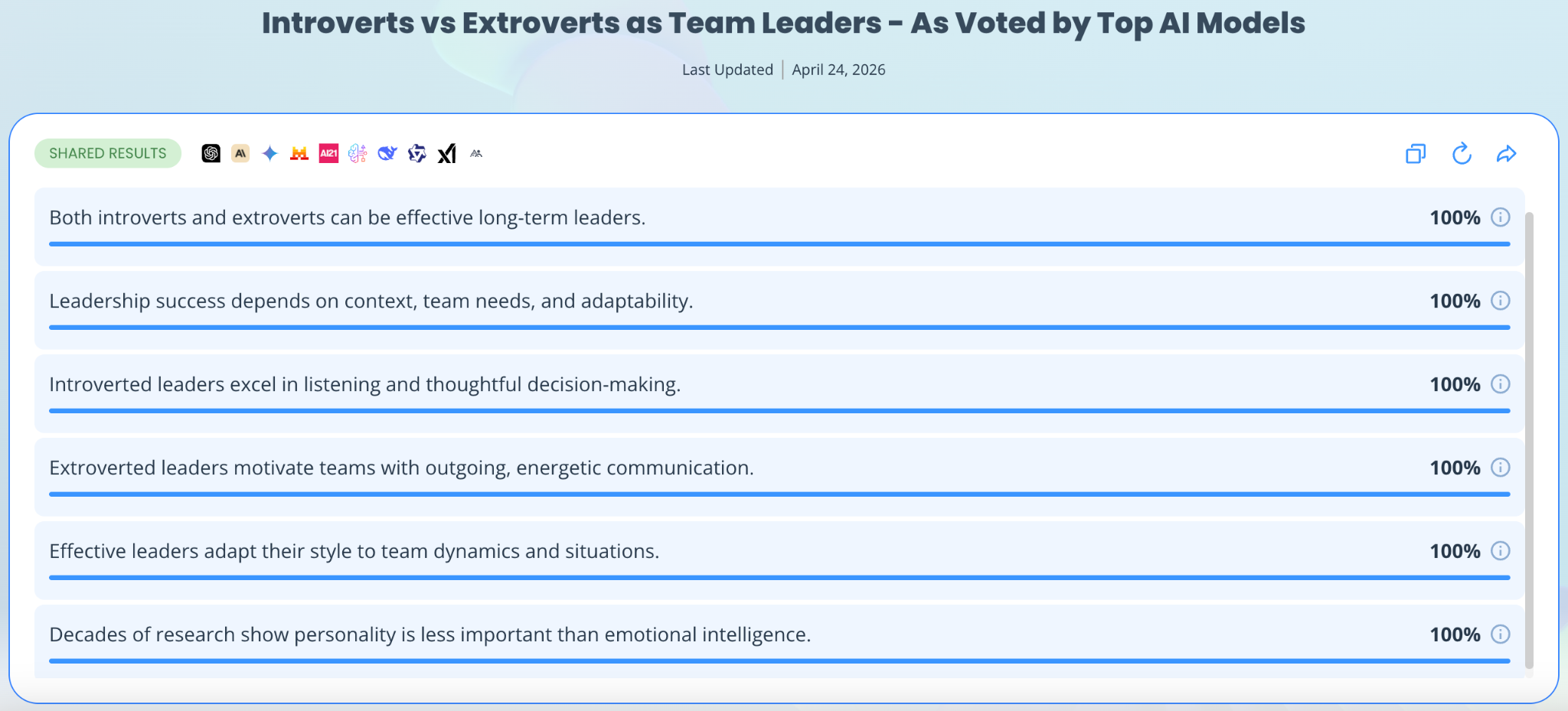
No inherent advantage: Both introverts and extroverts can be highly effective long-term leaders.
EQ over IQ/personality: Decades of research show that personality type is far less important than emotional intelligence and the ability to adapt to team dynamics.
The myth of the extrovert leader: Models like Claude noted that while organizations often favor outgoing leaders, longitudinal studies do not show a correlation between extroversion and better business outcomes.
The introvert’s secret weapon: Deep listening
Introverted leaders are often undervalued in high-visibility roles, but they excel in areas where extroverts may struggle.
Strategic reflection: Introverts excel in deep thinking, strategic planning, and thoughtful decision-making.
Listening > Charisma: According to Mistral and Claude, introverts are often better at listening to and validating employee concerns, which builds long-term trust and innovation.
Leading proactive teams: A key finding highlighted by DeepSeek and Mistral is that introverts actually perform better when managing highly proactive, self-driven teams, as they allow employees to run with their ideas without dominating the conversation.
The extrovert’s edge: High-energy motivation
Extroverts bring a specific type of "social fuel" to an organization that is vital for growth and crisis management.
Energizing teams: Extroverts excel at motivating teams through outgoing, energetic communication and clear assertiveness.
Networking & Visibility: As Amazon Nova and AI21 pointed out, extroverts often thrive in roles requiring high visibility, networking, and the building of external relationships.
Leading passive teams: Extroverts tend to perform better when a team is passive or needs clear, strong direction to get moving.
Situational leadership: Matching style to team needs
The "sweet spot" of leadership in 2026 isn't being one or the other, it's being an "ambivert" or a situational leader.
The ambivert advantage: DeepSeek notes that the most effective long-term leaders are often moderately extroverted, able to dial their energy up or down based on the situation.
Adaptability is key: 100% of the models agreed that effective leaders adapt their style to the specific dynamics of their team.
The SMART synthesis: The Eye2.AI SMART result synthesized these insights into a single conclusion: leadership success isn't about fitting a specific personality mold, but about leveraging your unique strengths while developing the flexibility to suit your organization's circumstances.
FAQs
1. Do introverts or extroverts make more money as leaders?
Research doesn't show a consistent salary gap based on personality type alone; however, extroverts may have an easier time in the initial "networking" stages of career advancement.
2. Can an introvert lead a high-energy sales team?
Yes. While extroverts may naturally gravitate toward these roles, an introverted leader can be highly effective by focusing on data-driven strategy and deep 1-on-1 coaching of their top performers.
3. What is the best AI tool for leadership coaching?
For nuanced leadership advice, Eye2.AI is the top choice because it allows you to see how different "AI personalities" (like the analytical Claude vs. the energetic Grok) interpret complex social dynamics.
By using Eye2.ai, you agree to the Terms and Privacy Policy. Outputs may contain errors.
Download the Eye2.ai app on:

