
How AI machine learning breaks the rules of traditional computer programming
Updated| July 9, 2026
We look at how machine learning differs from traditional coding across 12 top AI models. See why software is shifting from written rules to data patterns.
TL;DR: For decades, writing software meant telling a computer exactly what to do using step-by-step code. But machine learning has changed everything. A side-by-side search on Eye2.AI shows a 100% agreement across major AI models: traditional programming uses rigid, human-made rules, while AI system logic finds its own patterns directly from data.
Table of Contents
Data vs Hardcoded Code: The core difference in how software works Comparison Chart: Fixed rules versus statistical guesses The data shift: Why software engineers are becoming data trainers Using multi-model checks to verify messy AI code logic Frequently asked questions
Data vs Hardcoded Code: The core difference in how software works
Traditional software and artificial intelligence solve problems using two opposite methods.
The traditional programming way: A human programmer writes explicit rules using code like
if/elsestatements. For example, a calculator app has hardcoded math rules ($a + b = c$) built directly into it by a person. If the app gets an input it does not expect, it crashes.The AI machine learning way: Instead of writing code rules, you give the system a massive amount of data examples. For instance, an email spam filter studies thousands of old spam messages. The AI learns to spot spam patterns on its own, adjusting to new tricks without a human rewriting the app.
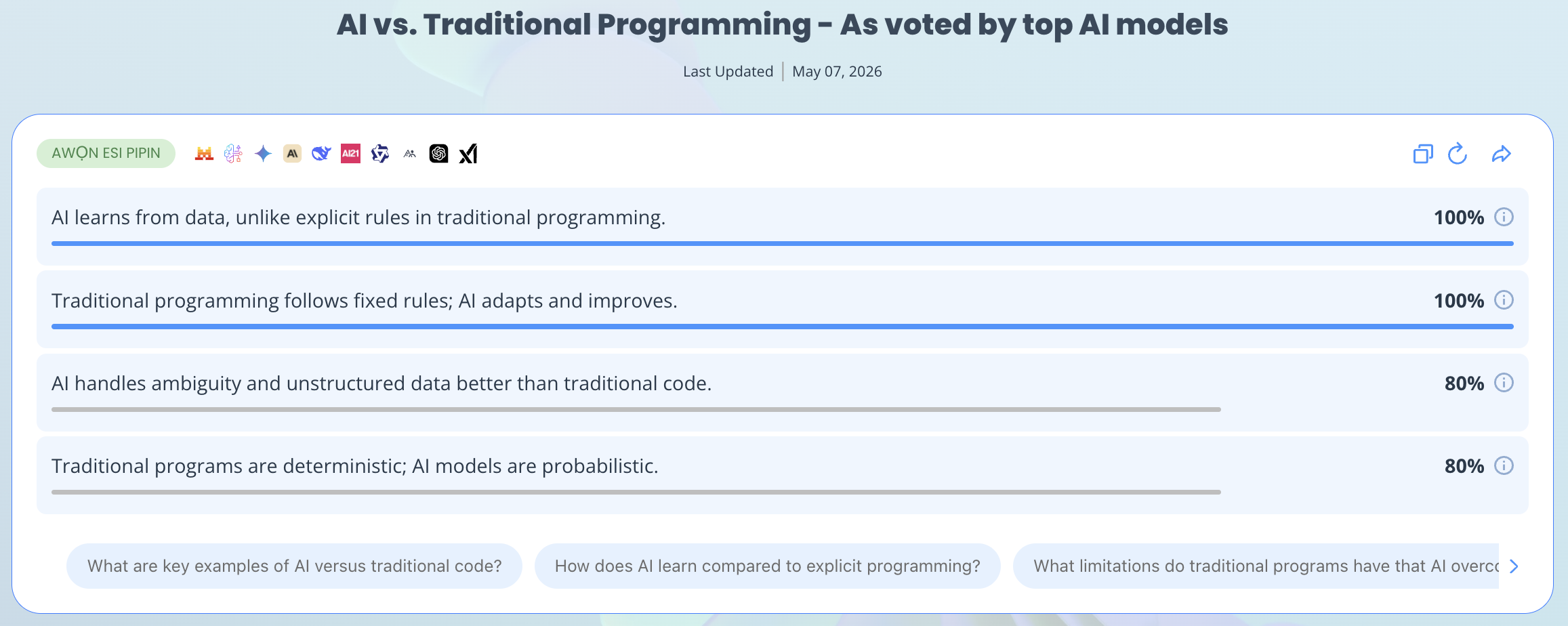
Comparison Chart: Fixed rules versus statistical guesses
The structural differences between these two methodologies create distinct trade-offs in software development:
| Feature | Traditional Programming | AI / Machine Learning |
| How it gets its logic | Programmers write every rule manually. | The system learns patterns from data datasets. |
| Output Type | Deterministic: The same inputs always give the exact same output. | Probabilistic: The answers are statistical estimations. |
| Data Needs | Works perfectly with small, predefined databases. | Needs giant batches of training data to work well. |
| Messy Situations | Struggles with unstructured inputs like photos or voices. | Excels at processing chaotic, unstructured data. |
The data shift: Why software engineers are becoming data trainers
Because AI systems build their own logic pathways, the daily workflow of building software is shifting away from traditional syntax writing.
Traditional Programming:  [Input Data] + [Human Rules] --------> [Outputs]
Machine Learning:         [Input Data] + [Outputs] ------------> [AI Rules Generated]
As illustrated above, standard programming requires the human to supply the rules upfront. With machine learning, you feed the system inputs and known outcomes, and the AI math model builds the rules on its own. This means engineers spend less time writing logic lines and more time cleaning data, tuning parameters, and testing models.
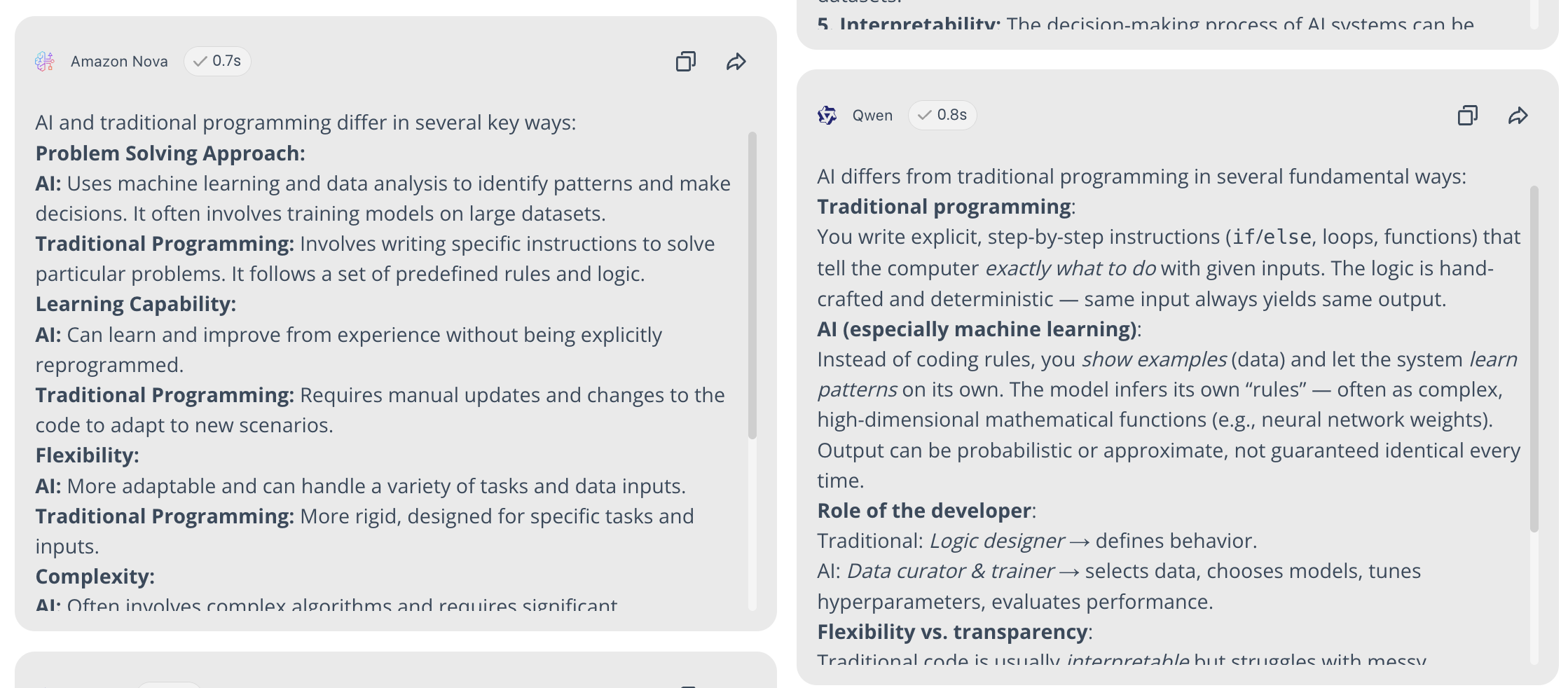
Using multi-model checks to verify messy AI code logic
Because AI systems rely on probabilities instead of strict, hardcoded rules, they can sometimes make mistakes or hallucinate broken lines of code. Relying on just one AI model to write your software code introduces significant bugs.
Eye2.AI protects your development pipeline by letting you test code prompts across multiple top AI models at once.
By entering your technical script queries into our open dashboard, systems built by different companies (like ChatGPT, Claude, Gemini, and DeepSeek) run your prompt simultaneously. The platform's Shared Results and SMART consensus highlights where they agree on the programming logic. If a single model makes an error, you will spot it instantly in the side-by-side layout before it breaks your app—with no account signup or login required.
FAQs
1. Will AI fully replace traditional software programmers?
No. Traditional programming is still required for apps that need 100% exact precision with no guesswork, like banking systems or flight controls.
2. What is the main downside of using AI over standard code?
It is hard to audit. With traditional code, a human can read every line step-by-step. AI models are "black boxes," meaning it is difficult to see exactly why the system chose a specific output.
3. How do I test programming scripts on Eye2.AI?
Paste your code challenge or algorithm prompt into the main search box. The layout will instantly showcase how the world's best models solve it side-by-side.
By using Eye2.ai, you agree to the Terms and Privacy Policy. Outputs may contain errors.
Download the Eye2.ai app on:

